

PROCESS 01
Process
Production Capacity
How to Make Denim
RAW COTTON
01
Raw Cotton
Raw cotton collected from all over the world supports the production of denim.
The quality of denim is largely influenced by cotton as the raw material. The characteristics of raw cotton vary depending on the soil, water and climate of the land as well as fluctuations in yield and quality. Taking these risks into account, LZM maintains raw cotton stocks equivalent to approximately 4 to 5 months of sales.
As raw cotton is compressed in bales of approximately 225kg, the bales are first unpacked. Afterwards, in order to stabilise the quality, the cotton undergoes a blending process, where it is unravelled and dirt, leaves and other substances are removed.

PROCESS 02
How to Make Denim
SPINNING
02
Spinning
Raw cotton transformed into yarn in perfect order
The spinning process is mainly carried out by ring spinning and free-end spinning equipment. The former is used for filament yarns and the latter for staple fibre yarns. The process of making a yarn consists of five processes: carding, in which the fibres are arranged in rope-like bundles in the same direction; stretching, in which they are further bundled and loosely twisted; roving, in which they are further twisted into a yarn as thick as udon noodles (roving); worsted, in which the roving is strongly twisted into a single piece of yarn; and finishing, in which the final inspection is carried out. The spinning process, in which temperature and humidity are strictly controlled, is automated to achieve high productivity.

PROCESS 03
How to Make Denim
DYEING
03
Colouring
The highest level of attraction from indigo dye
Using a combined sizing and dyeing machine, often called piece dyeing, sizing and dyeing are done together. Cotton yarns are soaked in the sizing and dyeing cylinders at a constant speed of about 24-30 m/min, forming a film of sizing on the yarn and dyeing it with the desired colour. The sizing mainly serves the purpose of making the hairs lie on the ground, strengthening the yarn, and enabling the yarn to be put on the loom for weaving.

PROCESS 04
How to Make Denim
WEAVING
04
Weaving
The world’s leading innovative weaving machine in action
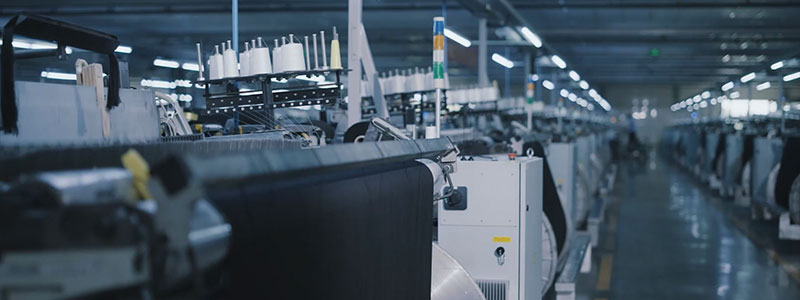
The healded weaving shafts are placed on the loom for weaving, which is also divided into five main parts, lifting the heald, drawing in the weft, opening the weft, winding the weft and feeding the warp, which are carried out by five different mechanisms. Rapier loom because of the fast speed, precise weft draw-in, weft force, cloth full and tight, the existing world’s leading loom manufacturer Yida Group denim fabrics dedicated loom, Yida R9500 high-speed rapier loom 350 units.
PROCESS 05
How to Make Denim
FINISHING
05
Finishing process
Finalised after rigorous inspection
Woven denim is sent to the grey fabric inspection process in order to confirm the quality of manufacture against specifications. As soon as a problem is detected, it is fed back to the previous process to make the required corrections. This close and efficient co-operation is a unique benefit of integrated production. After the blank inspection, the denim is sent to the finishing process.
After these treatments, the denim again enters the inspection process to check that it meets the quality standards. Six items are carefully checked by professional staff using testing equipment: tear strength, colour difference (unevenness and variation of colour), degree of prevention of skewing, tensile strength, rigidity (softness of hand) and wash shrinkage. Only denim that passes this rigorous inspection is shipped as LZM products.
